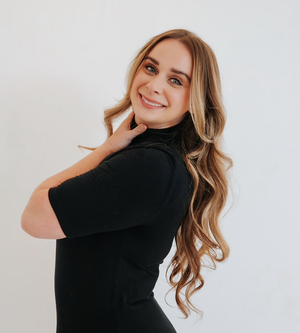
A Little More to the Left: Allyson Amanda Coan debuted her solo show at Maison du Solstice.
By Ali Taylor, Founder — ouyi Creative
The day before the show is always the one nobody talks about.
It's the day of "a little more to the left" and "I need waters" and the kind of laughter that fills a room before the guests do. It's the day the work goes up on the walls and the space stops being a space and starts being something else entirely — a world someone built by hand, hung by instinct and stepped back from just long enough to know it was right.
The day before Maison du Solstice's first art gallery showcase was my favorite day of the whole thing. Allyson Coan arrived with two of her closest friends, her paintings rolled and wrapped and ready. We spent hours staging the room — debating angles, adjusting heights, moving pieces an inch here, an inch there — until the work found exactly where it wanted to live. There were laughs. There were water breaks. There was that specific kind of easy chaos that only happens when the right people are in the right room doing something that actually matters to them.
By the time we were done, the space had transformed.
The Referral
I came to Allyson through a referral. Coordinating an art gallery-style partnership was new territory for me. ouyi Creative hadn't done anything like it before and I knew from the start that I needed someone who was authentic, genuinely kind and down for the process. Someone who would show up for the work and for the moment in equal measure.
Allyson was exactly that. And then some.
From the first conversation, her kindness set the tone. There was a naturalness to how we spoke — curiosity building off curiosity, ideas finding each other the way they do when two people are actually listening. When she agreed to debut her solo show at Maison, I felt honored. It wasn't just a partnership. It was alignment — the kind you recognize immediately and don't take for granted.
She was ready for her moment. The work was ready. And together, we were about to give it a room.
What You See First
Allyson's paintings have a specific instruction built into them — even if she never says it out loud.
Start from across the room.
"The paintings are designed to be first beheld from afar," she explains. "Striking and simple compositions to greet you from across the room." At a distance, they land with the confidence of something that knows exactly what it is — bold shapes, clean movement, a visual statement that doesn't ask for your attention so much as simply command it.
Then you move closer. And closer. Until the painting fills your entire field of vision. And that's when the real conversation begins.
"Come closer — so much so that the painting fills your field of vision — and you'll find a rich microcosm of the delicious interactions that happen between pigment, water, and painter."
Pigment. Water. Painter. Three things in constant dialogue, and Allyson is just one of them. Up close, her work reveals a texture and a life that the overview doesn't prepare you for — layers of decision and chance, moments where the material did something unexpected and she followed it, marks that feel as inevitable as they do surprising.
What does she hope you feel standing there? Before you try to name it, before you reach for a word?
"Beauty," she says simply. "I hope that in addition to whatever it is that strikes people in these works, that they also experience beauty."
It sounds simple. It is anything but.
What Never Makes It Onto the Canvas
Ask Allyson about her process and she'll tell you about two things: nature and spiritual experience.
"These two great muses defy to be captured by any artist's work," she says — and she means it not as a limitation but as a kind of freedom. The texture of tree bark. The quality of light through leaves. The stillness of meditation. These are the sparks. But they are not the painting.
"Though the texture of tree bark or the experience during meditation may spark the creative impulse, these inspirations don't themselves make it onto the canvas."
What happens between inspiration and finished work is where the real story lives. "Visual abstraction is a long, mysterious, fun, and exhausting process," she says. "Moving from the source of inspiration to the finished work… it's a wonderful and unexpected journey every time."
Every time. Not some of the time. Not when the conditions are right. Every time.
That's not a process. That's a practice. The kind of commitment to uncertainty that most people spend their whole lives avoiding, and that Allyson has built an entire body of work around.
Finding the Language
There's a moment every artist is looking for, maybe without knowing it, when the work stops feeling like an attempt and starts feeling like a voice. When what's on the canvas is not just something you made but something that could only have been made by you.
For Allyson, that moment didn't arrive on a single day. It arrived slowly, over years, through the accumulation of everything that didn't quite work.
"It took so many attempts before that to find something that felt remotely like a genuine expression," she says. "And then years of refining that offering."
How does she know she's found it now?
"I genuinely love my own work." She pauses; not dramatically, just truthfully. "So much so that I have paintings hanging in almost every room in my home."
The measure of arriving at your own language is that you want to live inside it. That the work doesn't feel like output — it feels like company.
When the Painting Belongs to Everyone
There is a word, sonder, for the dizzying realization that every stranger you pass is living a life as fully rendered as your own. A whole interior world, as vivid and complex as yours, unfolding behind a face you'll never know.
Abstract art does something similar. It holds a feeling so specifically that a stranger walks up to it and sees themselves. Their memory. Their grief. Their particular shade of joy. Something they thought existed only in their own interior and there it is, somehow, on a canvas.
I asked Allyson if a piece of work — hers or someone else's — had ever made her feel that. Like something she thought was only hers was somehow already captured.
"This idea of sonder is actually one of my favorite things about art, and abstract art in particular," she says. "There's no telling how two different people. or two thousand different people, will experience the work. Yet perhaps the only guarantee is that they will do so differently."
And what happens when the work leaves her hands?
"When I finish a painting and release it into the world, I must also release whatever it means to me. Because after it's done, I'm just another viewer."
Read that again.
After it's done, she's just another viewer. The artist becomes audience. The meaning she carried through every layer, every decision, every moment of doubt and certainty — she lets it go. And what's left is something that belongs to whoever is standing in front of it.
That's not just a philosophy of art. That's an act of generosity.
The Night the Room Was Hers
The show opened. The guests arrived. They walked in the way people walk into rooms where something real is happening — a little slower, a little quieter, heads already turning.
And then they did exactly what Allyson's paintings ask you to do. They stood back first. Took in the whole room. Let the compositions find them from across the space. Then they moved closer. One step, then another, until the work filled their field of vision and the conversation between pigment and water and painter had a new participant.
She arrived with two friends, a stack of paintings, and exactly the right energy for what Maison needed that weekend. She left with walls full of work and a room full of people who, for just a moment, saw something in her paintings that they thought was only theirs.
She would say that's the whole point.
I think she's right.
Allyson Amanda Coan is a Denver-based abstract artist. Follow her work at @allyson.amanda.art.